

It’s O for Orchids this week. These strange and rather beautiful plants belong to one of the largest families in the plant kingdom, ranging from gaudy tropical orchids to some rather inconspicuous British ones, but they all share some fascinating features. From April onwards they begin to appear in the wilder parts of the Norfolk countryside and even in gardens if you’re lucky. This morning I spotted four Early Marsh Orchids growing near our pond and next month the Bee Orchids should take their place on a nearby grassy knoll. Not far away, in the slack between the sand dunes at Burnham Overy Staithe, are more orchids, their dense spikes of purple flowers contrasting vividly with the bright egg-yolk yellow of the bird’s foot trefoil.
Unlike the majority of our flowering plants, orchids produce tiny, almost dust-like seeds with no food-store. Millions may be released by one plant, but the chances of any reaching maturity are remote. First, each tiny seed is at the mercy of the wind for its final destination, the vast majority landing in places entirely unsuitable for growth, but even if they do end up on fertile, moist soil in the correct habitat, they face another huge challenge: all orchid seedlings depend on a fungus partner to feed them for at least part of their life. Finding that special fungus at exactly the point of germination is essential if the plant is to survive. Such a partnership is what we call a symbiosis – both partners gaining from the relationship. Another, more accurate description for this particular partnership is mycorrhiza – literally meaning fungus-root, as the fungus actually invades the embryo orchid root and supplies it with nutrients from the soil. However, modern research has shown that this symbiotic relationship is far from equal at times – it’s more a battle between the orchid and the fungus, with the fungus in the ascendancy in the autumn and winter and the orchid in the spring and summer.
Either way, the outcome is that the young orchid root is supplied with food until it finally develops leaves and can manufacture its own food by photosynthesis. Now comes the astonishing bit: the root can remain underground without producing a green shoot for many years. In the case of the so-called Burnt Orchid, found in a few localities in Norfolk, this underground phase lasts between ten and fifteen years before the first green shoot and leaves appear above ground. Flowering then takes a further two or three years to occur, so it may be as many as eighteen years from seed to first flowering in this species. During this time, there are many subterranean perils that can prematurely end the orchid’s life – nematodes and burrowing mammals to name just two. With a life cycle so fraught with hazards, it’s little wonder we’re warned not to pick orchid flowers. Just one spike of Burnt Orchid flowers casually picked to put in a vase and nearly twenty years of effort to produce seeds is wasted. In the case of the beautiful Bee Orchid, this is even more of a disaster, as this species is one of our few monocarpic orchids – it flowers only once, then dies.
Assuming the orchid survives to this stage, most of our species then build up food in special underground storage organs called tubers. The Early Purple Orchid and its relatives have two such tubers in the height of the growing season. Being spherical and of a particular size, these tubers are reminiscent of some familiar human male attributes – hence the Latin name Orchis, which comes from the Greek for testicle. Other orchids have different shaped tubers. The Marsh and Spotted Orchids, for instance, have up to five, finger-like tubers – hence their Latin name Dactylorhiza, literally meaning finger roots.
As if these strange characteristics weren’t fascinating enough, orchid flowers are exquisitely engineered for a very unusual form of pollination. They all present their pollen in two special sacs called pollinia, inside flowers of a highly intricate shape, designed to prevent all but the correct sort of insect to be able to reach their nectar.
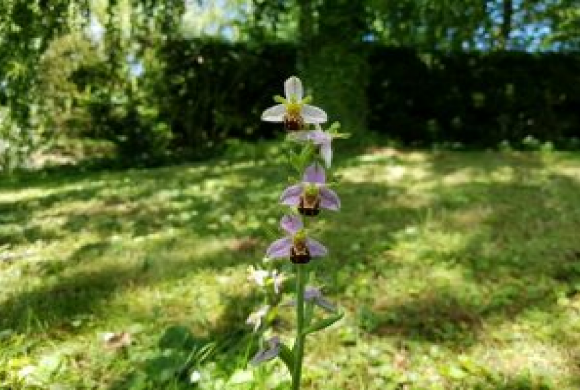
Most of our orchids attract their insect go-betweens with scent and colour and reward them with nectar, but a few – such as the bee orchid – have flowers that look and smell so much like a female of the pollinating insect, that the male is completely duped and tries to mate with it. In his efforts, he unwittingly touches the pollinia and this is enough to stick them firmly to his head. The glue is so strong and so instant in its effect that, try as he might, he can’t scrape the pollinia off. In his frustration to find a mate, he flies off and is lured to the next bee orchid by the same female sex pheromone. This time, the pollen he’s carrying on his head is inadvertently rubbed onto the receptive stigma, so the orchid is pollinated.
The bee Orchid’s beautiful flowers may not look much like insects to us, but there is something tantalisingly alluring about the combination of colour, shape, smell and texture that tricks the bee. The lower petal of the orchid is even hairy, mimicking the hirsute body of the female bee. He gets nothing for his efforts except an unwelcome load of pollen he can’t remove.
Such precise floral adaptations are a thing of beauty to us, but they play a vital role in the life of the orchids. Without such intricate designs, pollination would be a very hit or miss affair, something orchids can’t risk when the chances of any of their millions of seeds germinating and becoming mature plants are so slim. It’s for this reason, too, that orchid flowers tend to be so long-lasting – giving their insect pollinators every possible chance to do this crucial job.
Picking orchids may be against the law, but now is a great time to go out and photograph them and see for yourself how fascinating they really are.
Leave a Reply