

Last month I delved into the world of birds and migration. For August it’s caterpillars. You’ll know from my introduction that it was these that fuelled my interest in nature many years ago. In the 1950s, long before I was old enough to appreciate them, my father collected butterflies, but like many lepidopterists, he was less interested in their younger stages – the caterpillars. I, on the other hand, thought they were fascinating, and by the time I was eight I was severely trying my parents’ patience by bringing into the house all kinds of caterpillars to rear in jam jars on the windowsills. I even began to order them through the post from a wonderful organisation in Dorset called Worldwide Butterflies. Started by Robert Goodden in 1960, it still operates today. At the age of fifteen, when we lived in Harpley, I asked my mother and father if my brother and I could commandeer the spare room and turn it into a menagerie for breeding butterflies and moths. To their great credit, they agreed, and Peter and I soon hatched out spectacular Indian Moon Moths which flew eerily around our heads as we opened the door and walked in.
But it was the finding of special caterpillars in the garden and in local hedgerows that I found particularly rewarding. At this point I ought to clarify just what a caterpillar is. Like other insects, most butterflies and moths have six legs as adults and two pairs of wings. They belong to the scientific order Lepidoptera (meaning scaly-wings) on account of the thousands of tiny, overlapping scales that give their wings such vibrant colours and patterns.
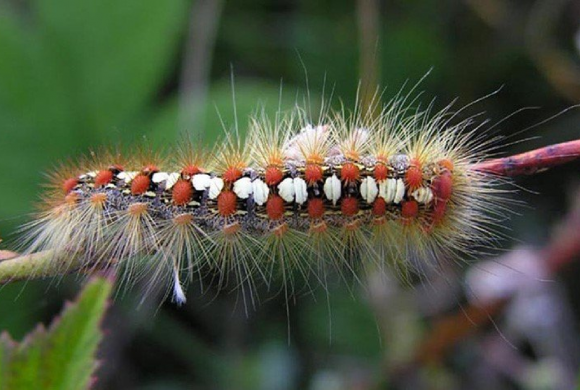
The caterpillar is the stage in the life of a butterfly or moth where all the growing takes place, so it’s no surprise that its body is just a simple expandable bag with efficient jaws, extra legs to hold it firmly on its food-plant and a strategy to avoid being eaten by predators. This strategy often involves camouflage, but some species adopt the opposite approach, advertising themselves blatantly with bright colours to warn that they’re poisonous to eat. If you walk down to the dunes at Burnham Overy Staithe or Scolt Head Island on a sunny day at this time of year, you may find both types if you’re lucky. The blatant one is likely to be the bright orange and black striped caterpillar of the Cinnabar Moth, feeding on ragwort, and the camouflaged one – harder to find despite its enormous size – will be the impressive caterpillar of the Privet Hawk Moth – one of Britain’s largest insects. For some unknown reason, the caterpillars of moths are often much more striking than those of butterflies and, as there are around 2,500 different kinds of moth in Britain, compared to just 59 species of butterflies, it was nearly always those of moths that I found and brought home to look after.
The north Norfolk coast is a special place for Lepidoptera – especially the large, fast-flying hawkmoths. Of the seventeen species of these that breed regularly in the UK or are frequent visitors, 14 have been found on the Norfolk coast since the year 2000. I’ve already mentioned the Privet Hawk Moth. When I first found the caterpillar of this moth as a boy, I couldn’t believe my luck. As any of you will know who’ve seen one yourselves, the full-grown caterpillar is truly magnificent – so spectacular in fact that its colour-scheme would seem to put it in danger of predation.
At 10 cm long, its only rival in size is the caterpillar of the rare Death’s Head Hawk moth which reaches an impressive 13 cm and feeds on potato leaves. As with nearly all hawk moths, the Privet Hawk caterpillar has a fearsome-looking – but harmless – curved horn at the back. In the case of the Privet Hawk, the horn is shiny black on top and bright yellow underneath, contrasting vividly with the luminescent green of the caterpillar’s body, along each side of which are seven diagonal purple and white stripes. Earlier I suggested that you might have difficulty spotting such a caterpillar, owing to its camouflage, but surely these colours would shine out like a beacon? Strangely, no. By daylight the Privet Hawk caterpillar stands motionless on a twig, the front part of its body rearing upwards like the Great Sphinx of Giza, after which it gets its Latin name – Sphinx ligustri (ligustri being the Latin for Privet). From a distance, the purple and white stripes look remarkably like the edges of the regularly arranged privet leaves on other, nearby branches.
It’s difficult to overestimate the excitement I still feel when I discover a hawkmoth caterpillar. There are two I’d particularly love to find in Norfolk, but so far they’ve eluded me. Like the Privet Hawk, both caterpillars are huge. The Convolvulus Hawk caterpillar is various shades of green or brown and has seven oblique yellow stripes, but compared to this, the Spurge Hawk caterpillar is positively gaudy. Its body is basically black adorned with large spots of red, yellow and white and the signal it sends to a would-be predator is unmistakable: ‘Don’t eat me – I’m poisonous!’ Let me know if you find one…
Leave a Reply